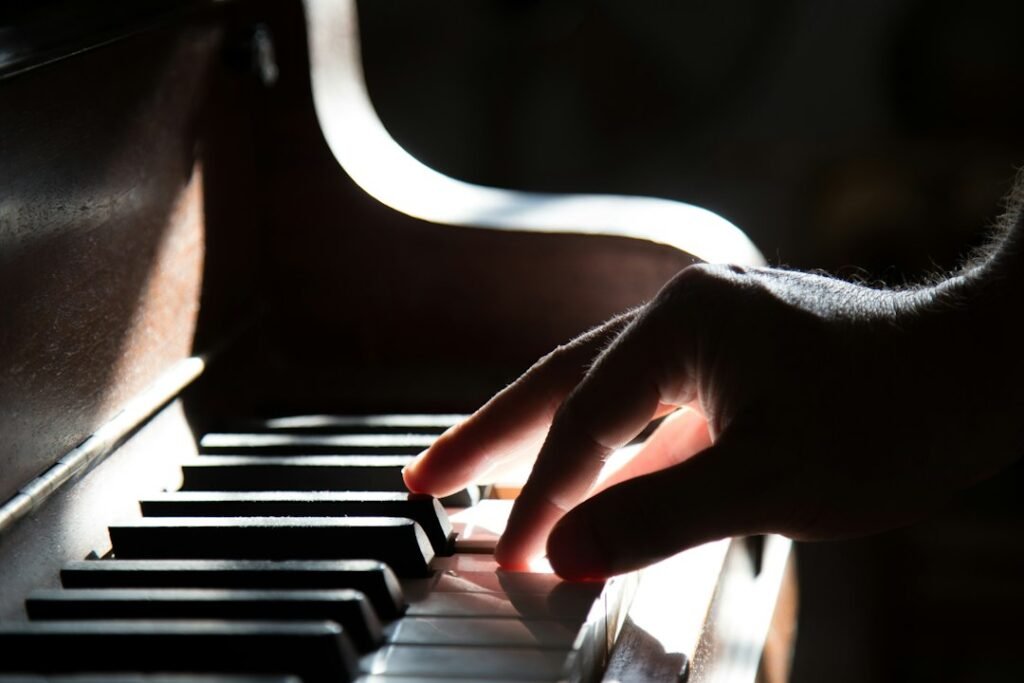
Starting piano as an adult can feel more complicated than it needs to be. You may be wondering whether you need an 88-key piano, whether you should learn to read music first, whether an app is enough, or whether you are already “too late” to begin.
The good news is that your first goal is much simpler: build a small routine that helps you understand the keyboard and play something recognizable. You do not need to master music theory before touching the keys, and you do not need an expensive setup before you know whether piano will become a long-term hobby.
1. Decide what “learning piano” means to you
Before choosing a course, teacher, app, or keyboard, decide what you actually want to do. Adult beginners often have very different goals.
- Play favorite songs: focus early on chords, melody, rhythm, and common song patterns.
- Learn classical piano: give more attention to reading notation, technique, dynamics, and eventually a full-size weighted keyboard.
- Play by ear: combine listening, chord recognition, melody matching, and simple theory.
- Relax and enjoy a new hobby: progress can be slower and more flexible; consistency matters more than speed.
You do not have to choose one path forever. The point is to stop measuring yourself against someone with a completely different goal.
2. Start with the keyboard you can realistically use
If you already have access to a piano or keyboard, use it. If you are buying your first instrument, do not assume that “more features” automatically means “better for learning.”
A conventional acoustic piano has 88 keys. Digital pianos often copy that full range and usually include weighted or graded action designed to feel closer to an acoustic piano. Smaller 61-key keyboards are more portable and can be perfectly usable for learning basic chords, melodies, rhythm, and many beginner songs.
If you are deciding between the two, see our beginner comparison: 61 Keys vs 88 Keys: What Does a Beginner Actually Need?
For someone who is serious about traditional piano technique and expects to progress into more advanced repertoire, an 88-key weighted digital piano is the stronger long-term choice. If budget or space is tight and you are still testing the hobby, a 61-key instrument can be a reasonable starting point.
More important than fancy sounds are basics such as full-size keys, touch sensitivity if possible, a headphone connection, a stable stand, and a comfortable bench or chair height.
3. Learn the keyboard map before memorizing lots of notes
The piano keyboard repeats the same visual pattern all the way across. Black keys appear in groups of two and three. That makes them useful landmarks.
Find any group of two black keys. The white key immediately to the left is C. From there, the white-key names continue C–D–E–F–G–A–B and then repeat.
Your first few sessions should include simple orientation:
- find several Cs across the keyboard;
- notice how notes move higher as you go right and lower as you go left;
- learn the finger numbers: thumb = 1 through little finger = 5 on each hand;
- practice finding notes without staring at labels stuck to every key.
Key stickers can feel helpful at first, but try not to depend on them. The goal is to recognize patterns on the keyboard itself.
4. Learn a few useful building blocks, not everything at once
A beginner does not need every major scale, every chord, and both clefs in week one. Start with a few ideas you can immediately use.
A sensible early sequence is:
- keyboard geography and finger numbers;
- steady counting in simple groups of four;
- a five-note hand position;
- a short one-hand melody;
- two or three simple major chords;
- then gradually combine both hands.
If your goal is popular music, simple chords can become useful very quickly. If your goal is traditional classical study, note reading and hand coordination may deserve more of your early attention.
5. Use a short practice routine you can repeat
For a busy adult, a focused short session is often more realistic than waiting for a free two-hour block. Yamaha emphasizes consistent, purposeful practice, and Roland similarly notes that short daily practice can be more useful than an occasional marathon session.
Here is a beginner-friendly 20-minute practice template. For a fuller routine, see How Long Should an Adult Beginner Practice Piano Each Day?
- 2 minutes — settle in: check your seat height, relax your shoulders, and place your hands comfortably.
- 4 minutes — keyboard map: find note groups, finger numbers, or a five-note pattern.
- 5 minutes — one small skill: a chord change, rhythm, scale fragment, or left-hand pattern.
- 7 minutes — music: work on a short melody or section of a song you actually want to play.
- 2 minutes — review: play the best version you can, then note what to continue tomorrow.
If you only have ten minutes, practice for ten. A small routine you repeat is more useful than an ambitious routine you avoid.
6. Pick one main learning method
Beginners now have more options than ever: teachers, online courses, apps, books, and free videos. The problem is not lack of information; it is often too much disconnected information.
Choose one main path for at least a few weeks:
- Teacher: best for personalized feedback, technique correction, and accountability.
- Structured online course: useful if you prefer self-paced lessons but still want an organized sequence.
- Learning app: convenient for guided practice and immediate interaction, especially at the beginning.
- YouTube: excellent for demonstrations and specific questions, but easy to turn into random lesson-hopping.
You can combine methods, but one should act as your roadmap. Use the others as support. For a fuller comparison, read Can Adults Really Learn Piano Online?
7. Practice slowly enough to notice mistakes
Beginners often assume faster playing means better playing. Usually the opposite is true during practice. Slow playing gives you time to notice fingering, rhythm, tension, and wrong notes before they become habits.
When a section goes wrong, make it smaller. Practice two measures instead of the whole song. Practice one hand. Reduce the tempo. Repeat the difficult transition rather than restarting from the beginning every time.
8. Use music you genuinely enjoy
Technique matters, but motivation matters too. If you love piano because of a particular artist, soundtrack, classical piece, or orchestral sound, let that influence what you learn.
You may not be ready to play the original arrangement yet. That is fine. A simplified melody, chord pattern, or beginner arrangement can still connect practice to the reason you wanted to learn in the first place.
A simple first-month roadmap
Week 1: learn the keyboard pattern, finger numbers, basic posture, and one simple melody.
Week 2: add steady counting, a few basic chords, and a second short piece or exercise.
Week 3: begin combining hands in very small sections and practice chord changes without stopping.
Week 4: choose one piece or song to polish, record yourself once, and decide what you want to improve next month.
What not to worry about yet
- Playing fast.
- Owning an expensive instrument.
- Learning every note instantly.
- Having “natural talent.”
- Comparing your progress with children who have been taking lessons for years.
Your first month should answer one question: Can I build a routine that makes me want to come back to the piano? If the answer is yes, you already have something worth building on.
Further reading
For additional beginner guidance, see Yamaha’s adult beginner course overview and Roland’s advice on finding time to practice: Yamaha adult piano courses and Roland: finding time to learn piano.