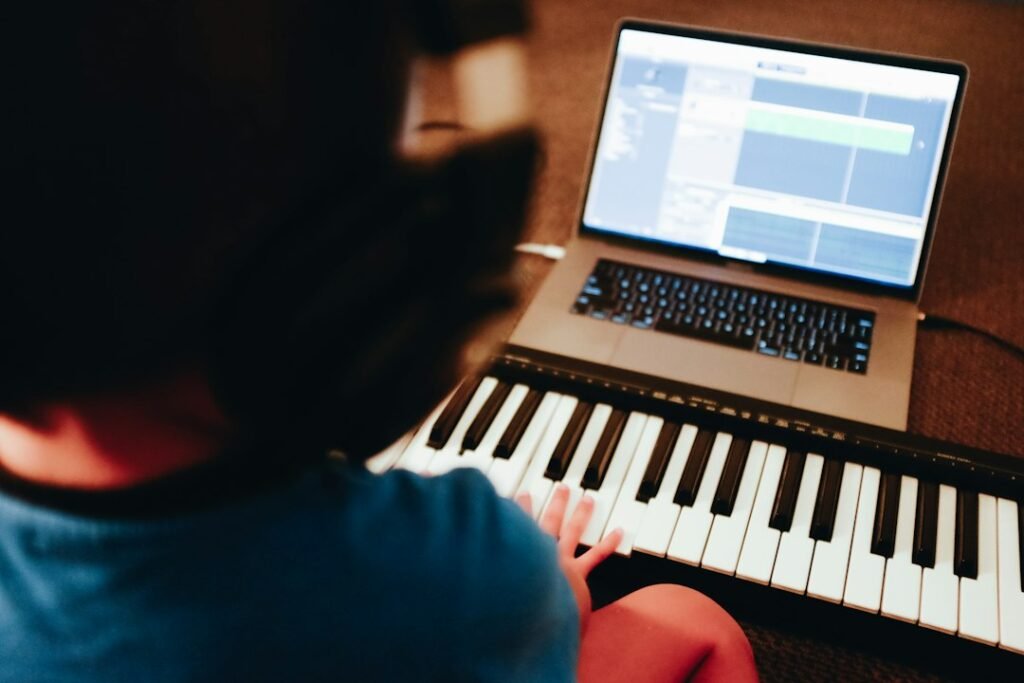
Yes, adults can learn piano online. The harder question is: which kind of online learning will actually keep you progressing?
There is no shortage of lessons. You can learn from YouTube videos, interactive apps, downloadable courses, live video teachers, or some combination of all four. The challenge is choosing a method that gives you enough structure, feedback, and motivation without overwhelming you.
First, understand what online learning does well
Online learning is especially good at removing barriers. You can start at home, repeat lessons as many times as you need, practice at your own pace, and often spend less than you would on regular private lessons.
It also makes demonstrations easy. You can pause a hand-position video, slow down a section, replay a chord explanation, and immediately try it on your keyboard.
The weakness is feedback. A video cannot always tell you that your wrist is tense, your fingering is making the next passage harder, or your rhythm is drifting. Yamaha’s own discussion of online learning highlights this trade-off: self-study is convenient, while live instruction offers stronger interaction and feedback.
Option 1: YouTube
Best for: demonstrations, specific questions, song tutorials, and free exploration.
Main advantage: enormous amount of free material.
Main weakness: lack of sequence.
YouTube is excellent when you know what question you are trying to answer. “How do I play a C major chord?” is easy to search. “What should I learn over my first six months?” is much harder, because ten good videos may still form a poor curriculum when watched in random order.
If YouTube is your main method, create your own structure. Pick one teacher or beginner playlist and follow it in order rather than jumping to whatever video looks exciting that day.
Option 2: Piano-learning apps
Best for: beginners who like interaction, visible progress, and guided repetition.
Main advantage: convenience and immediate engagement.
Main weakness: an app may reward correct notes without fully correcting posture, touch, tension, fingering, or musical expression.
Apps can be motivating because they turn practice into small tasks. They are also convenient if your digital piano connects to a phone or tablet. For some adults, that structure is exactly what makes daily practice happen.
The key is not to confuse completing app levels with becoming a complete pianist. Use the app as a tool, and occasionally play without the screen to make sure you can still find notes, remember patterns, and listen to yourself.
Option 3: Structured online courses
Best for: self-directed learners who want a clear beginning-to-end path.
Main advantage: organization.
Main weakness: quality varies, and prerecorded courses cannot give personalized correction.
A good beginner course should answer questions in the right order. It should tell you what to practice, give you examples, build one concept on another, and provide music you can actually use.
Before paying for any online course, look for:
- a clear beginner curriculum;
- sample lessons;
- an explanation of what skills are taught;
- information about the instructor;
- realistic claims about progress;
- transparent pricing and refund terms;
- evidence that lessons move beyond simply copying songs.
Avoid buying because of countdown timers, dramatic promises, or claims that one “secret” method removes the need to practice.
Option 4: Live online teacher
Best for: learners who want feedback, accountability, and a plan adapted to them.
Main advantage: a teacher can observe what you are doing and change the lesson accordingly.
Main weakness: scheduled lessons cost more and require you to be available at a specific time.
A teacher becomes particularly useful when you are unsure about technique, experiencing discomfort, preparing graded repertoire, or repeatedly getting stuck on the same problem.
Roland notes that one-to-one instruction remains valuable because a teacher can tailor the approach, guide you when you are stuck, and help keep you accountable.
Which method fits you?
| If you are… | Consider starting with… |
|---|---|
| Highly self-motivated and organized | A structured course plus selected YouTube support |
| Motivated by scores, streaks, and interaction | A learning app |
| Unsure about technique or easily stuck | A teacher, even if only occasionally |
| On a zero budget | One structured free playlist plus a written practice plan |
| Interested mainly in specific songs | YouTube tutorials plus basic chord/rhythm study |
| Planning serious classical study | A teacher or structured classical curriculum |
The biggest online-learning mistake: course hopping
It is easy to spend more time looking for the “best” lesson than practicing the current one. One teacher says learn scales. Another says learn chords first. A third promises to teach songs immediately. Soon you have six tabs open and no routine.
Pick one primary method and stay with it long enough to evaluate it fairly. Give a sensible beginner program several weeks unless it is clearly unsuitable.
A practical hybrid approach for beginners
You do not have to choose online or teacher forever. A hybrid approach can be very effective:
- use a course or app as your weekly roadmap;
- use YouTube to clarify specific questions;
- record yourself occasionally so you can listen back objectively;
- book a teacher when you need technique feedback or a progress check.
This keeps the convenience of self-study while giving you a way to correct problems before they become habits.
A four-week online starter plan
Week 1: Keyboard orientation
Learn the pattern of black and white keys, finger numbers, basic sitting position, and one short right-hand melody.
Week 2: Rhythm and chords
Practice steady counting, add two or three simple chords, and start changing between them slowly.
Week 3: Coordination
Introduce a simple left-hand part or chord while the right hand plays a melody. Work in tiny sections.
Week 4: Finish something
Choose one beginner piece or song and polish it rather than continuously starting new lessons. Record a version at the end of the week.
How to know whether your online method is working
Do not judge only by how many lessons you completed. Ask whether you can:
- find basic notes more quickly;
- keep a steadier rhythm;
- change between simple chords with fewer pauses;
- play a short piece more cleanly than two weeks ago;
- understand what you should practice next.
If you are consuming lessons but none of those things are improving, change how you practice before buying another course.
When online-only learning may not be enough
Consider getting live help if you experience hand, wrist, arm, shoulder, or back discomfort; if you are repeatedly unsure whether your technique is correct; or if you are preparing for exams, auditions, or technically demanding repertoire.
Online learning is a powerful way to begin, but personalized feedback can save time when the problem is something you cannot easily see yourself.
The bottom line
Adults can absolutely begin piano online. The most successful approach is usually not the platform with the most features—it is the one that gives you a clear sequence, music you care about, and a practice routine you will actually follow.
Start simple. Choose one main method. Practice regularly. Add feedback when you need it. That is a far more reliable plan than searching endlessly for the perfect course.
If you are completely new to the instrument, start with our Adult Beginner Piano: Where Should You Start? roadmap.
Further reading
For more on the strengths and limitations of online learning, see Roland’s guide to learning piano online and Yamaha’s discussion of self-study and live online lessons.