
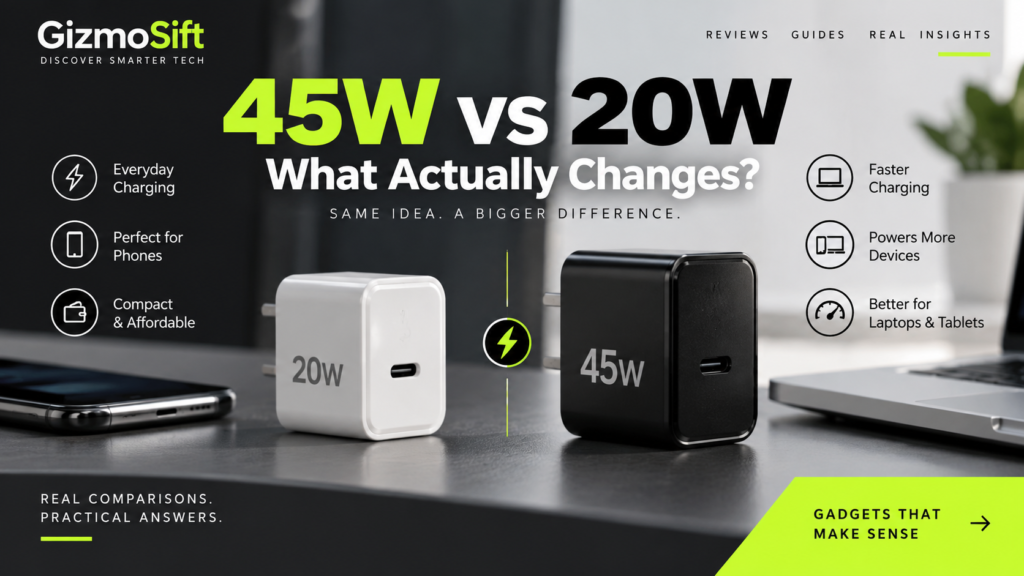
Charging wattage is easy to turn into a numbers race, but the useful question is simpler: what does moving from a 20W charger to a 45W charger actually change? The answer depends much more on the device you plug in than on the number printed on the adapter.
Quick answer: a 45W charger can deliver more power, but it will only charge a device faster if that device supports a higher charging rate and the cable and charging protocol are compatible. If your phone only asks for around 20W, a 45W charger does not force 45W into it.
20W vs 45W charging at a glance
| Question | 20W charger | 45W charger |
|---|---|---|
| Good for many phones? | Yes | Yes |
| Can charge supported devices above 20W? | No | Yes |
| Useful for tablets / larger USB-C devices? | Sometimes | Usually more flexible |
| Automatically faster for every device? | No | No |
| Best reason to choose it | Simple phone charging | More headroom across several devices |
Wattage is the charger’s maximum output, not a command
Watts measure power. A 45W charger has a higher maximum output than a 20W charger, but modern USB charging is negotiated between the charger and the device. The phone, tablet or laptop requests a supported power level, and the charger supplies an appropriate amount within its capabilities.
That means a higher-wattage adapter does not simply push its full rated power into every connected device. If a device is designed to accept less, it will draw less.
When can 45W actually charge faster?
A 45W charger can make a noticeable difference when the connected device supports charging above 20W. Depending on the product, that can include some smartphones, tablets, power banks, handheld gaming devices and smaller USB-C laptops.
The biggest difference is usually seen earlier in a charging session, when the battery is low and the device is willing to accept more power. Charging speed normally tapers as the battery fills, and heat, battery condition and the device’s own charging controls can reduce the rate further.
When is 20W still enough?
A 20W charger can still be completely practical if your main device does not support significantly more than that, if you mostly charge overnight, or if fast top-ups are not important to you.
For a phone that cannot make meaningful use of the extra output, moving from 20W to 45W may give you little or no improvement in charging time. More wattage is useful only when the rest of the charging system can use it.
Charging protocols matter too
Wattage alone does not tell the whole story. Devices and chargers also need to support compatible charging standards. USB Power Delivery is widely used, while some devices rely on features such as PPS or manufacturer-specific charging systems to reach their fastest supported rates.
So two chargers carrying the same wattage rating may not behave identically with every phone. If maximum charging speed matters, check both the device’s supported charging standard and the charger’s specifications.
The cable can limit the result
The charger is only one part of the system. The cable must also support the required power level and data used for charging negotiation. A damaged, low-quality or incompatible cable can prevent a charger and device from reaching the expected charging rate.
If a higher-wattage charger seems no faster than your old one, the cable is one of the first things worth checking—along with the device’s actual charging limit.
Why 45W can still make sense even for a lower-power phone
The strongest argument for 45W is often flexibility rather than phone speed. A single compact charger may be able to cover your phone, tablet, power bank and another USB-C device, reducing the number of adapters you need to carry.
That is also why we are watching compact 45W products such as the TORRAS FlashEye-Dot in our Gadgets section: the extra headroom can make one small charger useful across a broader mix of devices.
So, should you buy 20W or 45W?
- Choose 20W if you mainly charge a phone that does not benefit much from higher power and you want a simple, inexpensive adapter.
- Consider 45W if you own several USB-C devices, have a device that supports faster charging above 20W, or want one charger with more room for future devices.
- Do not choose by wattage alone. Check charging-protocol support, the device’s maximum wired charging rate and the cable you plan to use.
The best charger is not automatically the one with the biggest number. It is the one that matches the devices you actually use.